

Bird stocker TH // Shutterstock
A 3-step guide to connecting marketing spend to revenue
Marketing teams often find it challenging to demonstrate the revenue generated by their campaigns. To connect marketing spend to revenue, you need accurate attribution, complete data, and reporting that translates activity into results.
WebFX’s guide provides a practical framework for linking marketing spend to revenue. You’ll learn how to overcome common attribution challenges, maintain clean and accurate CRM data, and set up reporting that clearly ties every campaign to measurable ROI.
What is marketing attribution?
Marketing attribution is the process of tracking how marketing activities contribute to leads, pipeline, and revenue.
Strong marketing attribution connects every customer touchpoint, from first click to closed deal, so teams can see which channels and campaigns drive real business results.
If marketing attribution is broken, you’re likely struggling to:
- Prove marketing ROI
- Connect marketing spend to revenue
- Make confident budget and optimization decisions
That’s why marketing attribution has become one of the most important priorities for leadership.
Why marketing attribution breaks in most organizations
Marketing attribution breaks when data lives in silos.
Marketing platforms track clicks and leads. Sales systems track conversations and deals.
Revenue gets reported separately, often too late to guide decisions.
Without closed-loop marketing, teams rely on partial data, surface-level metrics, or assumptions instead of revenue-backed insights. This leads to inefficient spend, missed optimization opportunities, and ongoing pressure to justify marketing’s value.
Sound familiar? This is exactly why a clear, step-by-step approach to fixing attribution matters.
Your 3-step guide to connecting marketing spend to revenue
This framework is built for teams that want clarity and finally move toward closed-loop revenue reporting.
WebFX
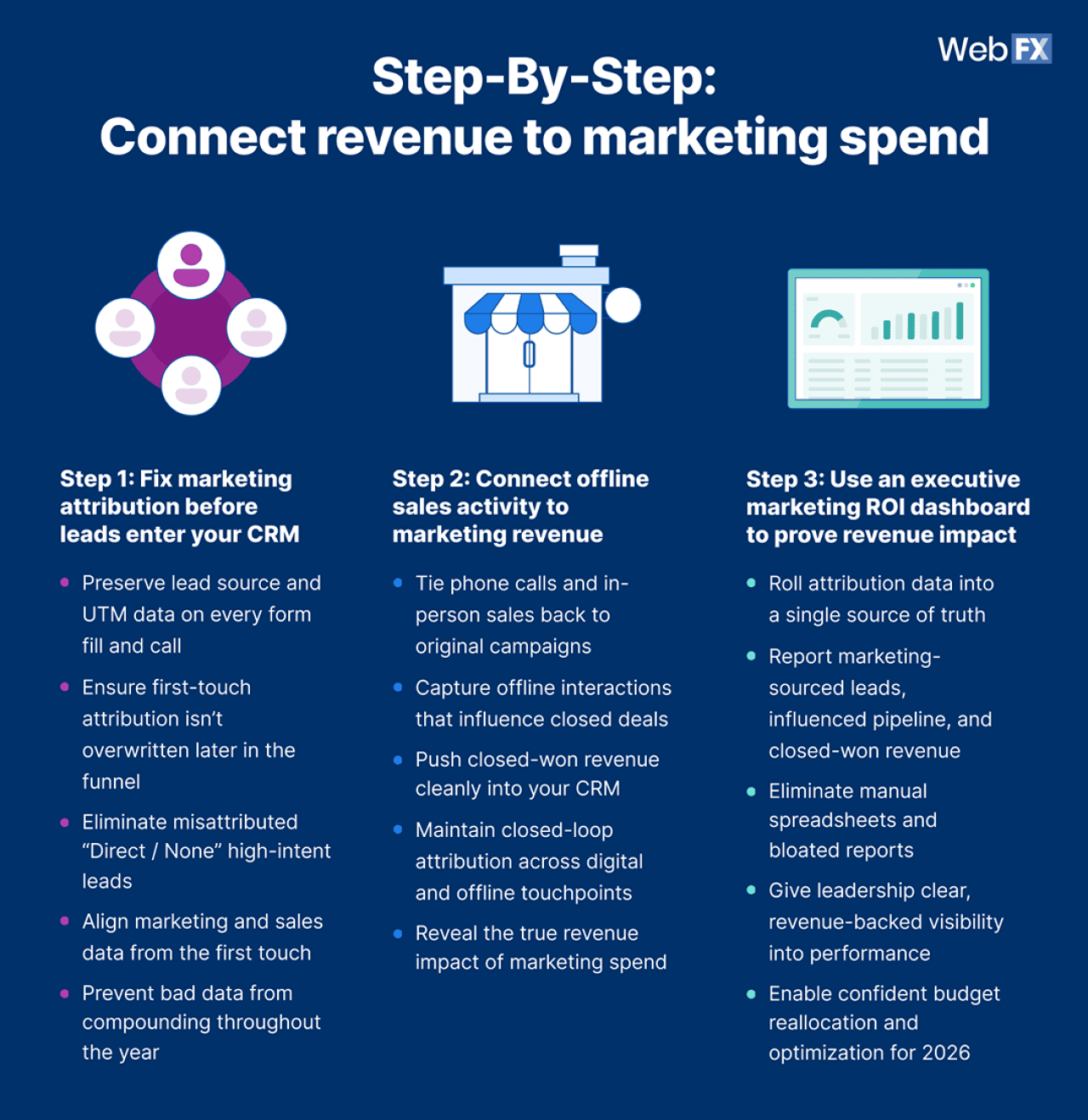
Step 1: Fix marketing attribution before leads enter your CRM
Traditional marketing setups break before results ever have a chance to show up.
Marketing data lives in one system. Sales activity lives in another. Revenue gets reported after the fact (if it’s reported at all). The result is a fragmented funnel where no one can confidently say which campaigns are driving real outcomes.
When marketing attribution breaks before a lead even enters your CRM, everything downstream suffers:
- Sales follows up without context
- Marketing optimizes based on surface-level metrics
- Budget decisions get made on instincts instead of marketing ROI
That’s how teams end up scaling what looks good, not what actually drives revenue.
Revenue marketing changes this by connecting data at the very first touch. With integrated revenue marketing platforms, marketing and sales data flow together from the start, creating a complete picture of how marketing spend turns into pipeline and revenue.
To start with, audit the fundamentals:
- Are lead sources and UTM data preserved on every form fill and call?
- Are first-touch sources stored correctly instead of being overwritten later?
- Are high-intent leads incorrectly lumped into “Direct / None”?
Fixing this early prevents bad data from compounding all year and sets the foundation for revenue-backed decisions that lower cost per lead, improve efficiency, and maximize ROI.
Step 2: Connect offline sales activity to marketing revenue
In 2026, many customer journeys still include offline steps before they close, but marketing attribution often stops before those moments are captured.
Prospects research digitally, submit forms, make phone calls, talk to sales reps, and close days or weeks later. When that offline activity isn’t connected back to the original campaign, revenue disappears from reporting even though marketing created the opportunity.
That gap creates real problems:
- High-performing channels get undervalued
- Sales revenue gets disconnected from marketing investment
- Optimization decisions get made on incomplete data
This is where revenue marketing data and closed-loop attribution make the difference.
With closed-loop attribution systems, offline interactions don’t live in isolation. Phone calls, in-person sales, and closed deals connect back to the campaigns that sourced and influenced them, giving you a true view of marketing’s revenue impact.
This step focuses on how to:
- Tie phone calls and in-person sales back to the original digital campaign
- Push closed-won revenue into your CRM in a clean, consistent way
- Implement offline conversion tracking without heavy development or ongoing maintenance
When offline revenue flows back into your marketing data, ROI finally reflects reality, allowing teams to reduce wasted spend, double down on what’s actually working, and make revenue-backed marketing decisions instead of educated guesses.
Step 3: Use an executive marketing ROI dashboard to prove revenue impact
Forget bloated reports no one trusts and the manual work it takes to maintain them.
With automated attribution tools, marketing attribution data doesn’t live in spreadsheets or disconnected CRM views. It automatically rolls up into a single executive-ready marketing ROI dashboard that shows exactly what leadership wants to see:
- Marketing-sourced leads
- Marketing-influenced pipeline
- Closed-won revenue tied directly to campaigns
This means decisions are based on real revenue performance, not assumptions, partial data, or whoever speaks loudest in the room. Teams can quickly see what’s driving results, reallocate spend with confidence, and avoid over-investing in channels that look busy but don’t produce revenue.
No custom builds. No ongoing cleanup. No explanation of how the numbers were calculated.
Just one view, one source of truth, and clear marketing ROI reporting, ready for 2026 conversations.
Traditional marketing vs. revenue marketing
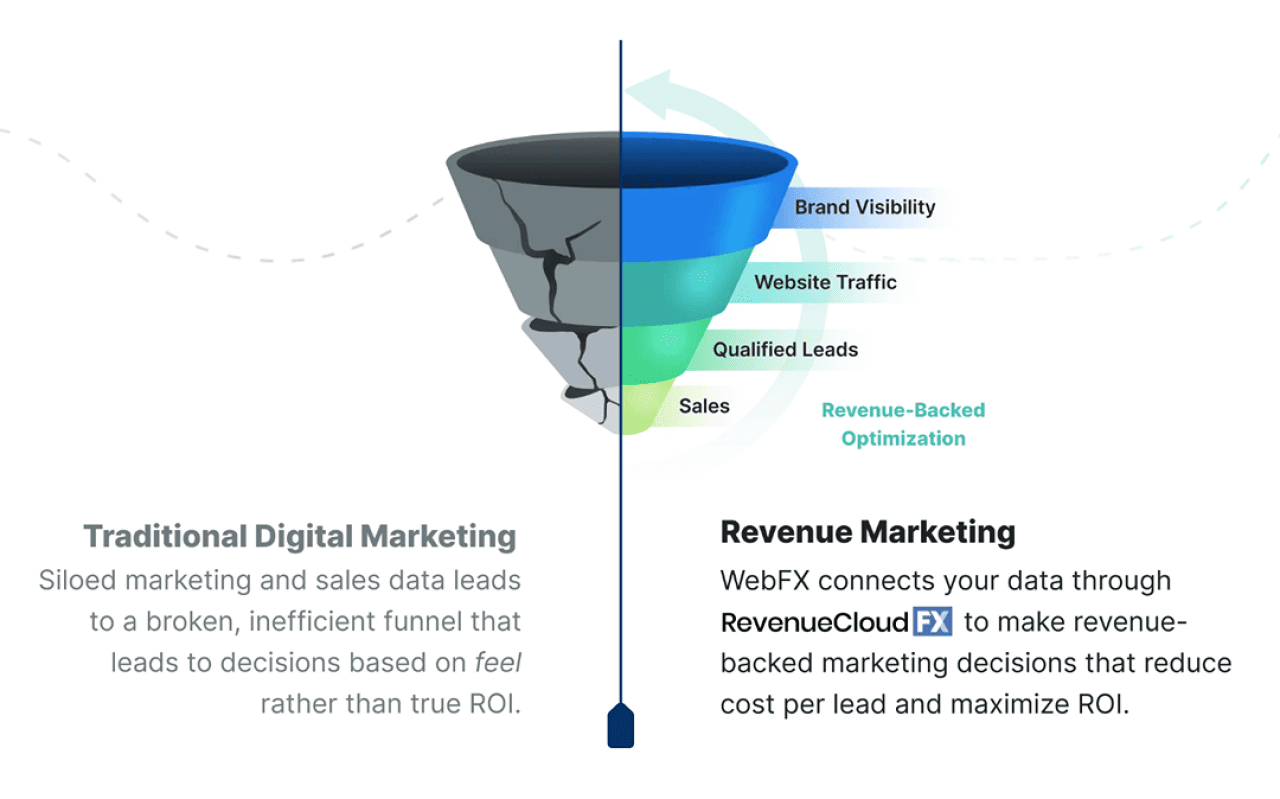
Traditional marketing focuses on traffic, leads, and channel performance, often without tying results back to revenue. Metrics live in silos, reporting happens after the fact, and optimization decisions rely on surface-level indicators like clicks or form fills.
Revenue marketing takes a different approach. It connects marketing, sales, and revenue data into a single system, so teams can see how campaigns actually contribute to pipeline and closed deals. Instead of reporting in isolation, performance is evaluated across the full funnel.
This shift replaces siloed metrics with connected insights and ongoing optimization. According to the 2025 Deloitte CMO Survey, organizations that operate this way achieve 1.8 times faster lead growth than the industry average, because decisions are driven by revenue impact rather than disconnected channel metrics.
WebFX
With revenue marketing, teams can track:
- Marketing-sourced revenue
- Marketing-influenced pipeline
- True return on marketing investment
The result is faster decision-making, lower cost per lead, and higher ROI, because optimization is based on what drives revenue, not guesswork.
Bonus: What to do when your CRM is working against you
If marketing attribution feels overly complex, the issue often isn’t your strategy. It’s the CRM you’re trying to force it through.
Many teams struggle with attribution because their CRM was built for sales tracking, not revenue marketing. Data becomes fragmented, attribution rules are hard to maintain, and reporting requires constant manual cleanup just to stay accurate.
This is where user-friendly CRM platforms can help. These systems are designed for teams that need clear visibility without unnecessary complexity. When paired with revenue-focused reporting, it helps simplify attribution, keep marketing and sales data aligned, and reduce the friction that causes reporting to break down over time.
For teams, the goal isn’t more tools or more dashboards. It’s a system that makes attribution easier to maintain, easier to trust, and easier to act on.
In many cases, the fix isn’t adding more tools. It’s choosing ones that are easier to manage and easier to trust.
Why revenue-connected attribution matters for your team
Marketing attribution doesn’t need to be perfect, but it does need to be clear, consistent, and revenue-connected. When teams can confidently trace marketing activity from spend to pipeline to revenue, the entire conversation changes.
When you fix attribution:
- Budget conversations get easier because decisions are backed by revenue data
- Leadership confidence goes up because performance is clear and defensible
- Marketing stops being questioned and starts being scaled
That’s the foundation smart teams are building to make faster decisions, protect budget, and drive sustainable growth.
This story was produced by WebFX and reviewed and distributed by Stacker.

