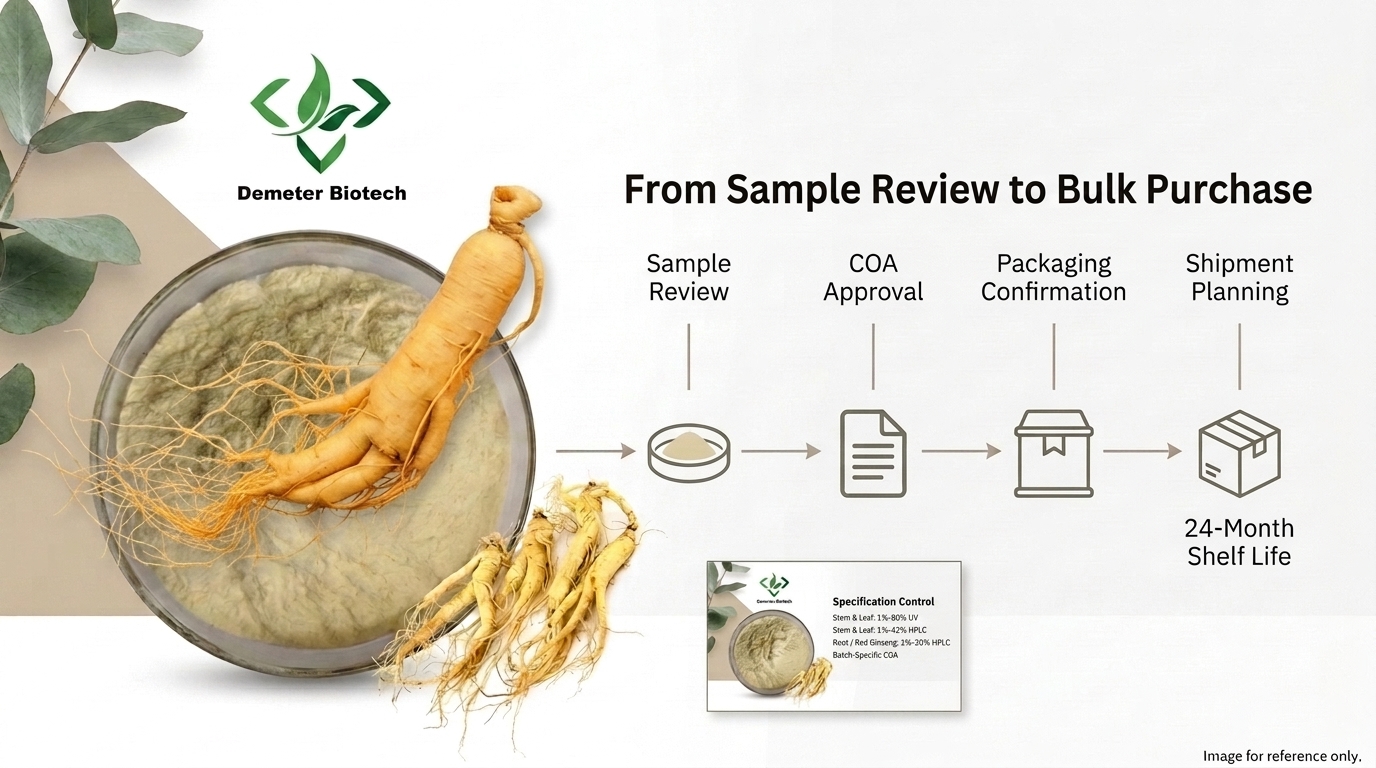

XIAN, SHAANXI, CHINA, September 1, 2026 /EINPresswire.com/ — Bulk ginseng procurement succeeds when species identity, plant part, active specification, analytical method, and export documentation are fixed before price negotiations begin. A China Premium Ginseng Extract Exporter therefore does more than offer a generic herbal powder: it converts Panax, American, Siberian, and Red Ginseng options into specifications that formulation, quality, and purchasing teams can compare. Demeterherb supports stem-and-leaf grades at 1%-80% ginsenosides by UV or 1%-42% by HPLC, root grades at 1%-30% by HPLC, plus sample, COA, packaging, and export support.
Demeterherb’s value to bulk ginseng buyers lies in keeping botanical identity and export execution in one order file. A distributor can align the selected species, root or stem source, ginsenoside target, sample approval, packaging, and destination documents before commercial release. Independent import and export capabilities, private label services, and delivery experience across more than 50 countries and regions support that continuity when one ginseng program serves several markets.
Species And Active Specifications Define Bulk Ginseng Value
Species and active specifications define the commercial value of ginseng extract before any discussion of volume discounts. Demeterherb’s range distinguishes stem-and-leaf extracts from root extracts and matches each grade to a defined ginsenoside range and analytical method. Stem-and-leaf extracts are available at 1%-80% ginsenosides by UV or 1%-42% by HPLC, while root and Red Ginseng extracts are available at 1%-30% by HPLC. This gives formulators a clearer basis for matching active concentration with dosage form, serving size, cost structure, and label positioning.
The analytical method belongs in the same decision. HPLC or UV testing provides a documented basis for confirming the stated ginsenoside level, and the COA connects that method to a specific batch. A higher percentage is not automatically the correct choice; the correct grade is the one that matches the formula and remains consistent from sample to commercial lot. Put simply: species, plant part, ginsenoside percentage, and test method form one product identity.
Demeterherb’s ginseng portfolio can be organized by plant part, assay range, and test method:
Core specifications include:
Ginseng Stem and Leaf Extract: ginsenosides 1%-80% by UV or 1%-42% by HPLC.
Ginseng Root Extract: ginsenosides 1%-30% by HPLC.
American Ginseng Stem and Leaf Extract: ginsenosides 1%-80% by UV or 1%-42% by HPLC.
American Ginseng Root Extract: ginsenosides 1%-30% by HPLC.
Red Ginseng Extract: ginsenosides 1%-30% by HPLC.
Additional formats include ginseng raw powder, ginseng extract, ginseng polysaccharides, Red Ginseng powder, Red Ginseng extract, and organic ginseng extract.
Pesticide-residue options can be aligned with the intended market and order specification:
Available positioning includes CP normal-pesticide-residue grades, USP/EC 396 low-pesticide-residue grades, and USP no-pesticide-residue grades.
A China Premium Ginseng Extract Exporter Must Support Organic and Standard Grades
Organic and standard ginseng grades require separate evidence chains. Demeterherb’s organic product catalog includes Ginseng Powder and Extract, Red Ginseng Extract and Powder, and Siberian Ginseng Powder and Extract under EU and NOP organic scope. That catalog basis supports organic sourcing for eligible SKUs, but the certificate scope, product name, lot documentation, and target market must still correspond to the exact order.
Standardized non-organic grades are evaluated primarily through species, plant part, ginsenoside content, analytical method, and application requirements. Organic status cannot replace active standardization, and a standardized assay cannot establish organic status. A professional China Premium Ginseng Extract Exporter keeps those claims separate, allowing a European importer to review EU organic coverage while a US buyer reviews NOP documentation without confusing either certificate with batch potency data.
COA, Packaging, And Shelf-Life Data Convert Samples into Purchase Specifications
Samples become purchase specifications only when the accompanying documents and logistics details are fixed at the same time. Demeterherb provides free samples and certificates of analysis, enabling buyers to compare appearance, identity, active content, and analytical results before approving a commercial order. A 24-month shelf life gives inventory planners a defined basis for shipment timing, warehouse rotation, and replenishment schedules.
Packaging options support both evaluation and scale-up. The available formats include a 1 kg aluminum foil bag, a 25 kg carton with an internal foil bag, and a 25 kg fiber drum. Those choices affect freight density, handling, moisture protection, and batch allocation across production sites. The most reliable sequence is sample review, COA approval, packaging confirmation, shipment planning, and commercial release. Without that continuity, a successful sample test does not guarantee an auditable bulk order.
Application-oriented grade selection should match the dosage form and performance requirement:
Health supplements: Red Ginseng root extract with 1%-20% ginsenosides by HPLC can be selected for supplement formulations.
Beverages: Ginseng root extract with 1%-3% ginsenosides by HPLC is suited to projects prioritizing water dispersibility and a manageable flavor profile.
Pharmaceutical-oriented ingredient projects: Ginseng root extract with 1%-30% ginsenosides by HPLC can be specified, including material sourced from roots aged more than five years when that requirement is part of the order.
Cosmetic formulations: Ginseng stem-and-leaf extract with 3%-10% ginsenosides by UV can be considered where color and water dispersibility are formulation priorities.
Ginseng raw powder can also be developed for capsules, tablets, and confectionery formats; ginseng extracts can be used in drinks and syrups; and ginseng polysaccharides can be used in supplement and beverage formulations.
Export Infrastructure Reduces Multi-Market Supply Friction
Export infrastructure reduces friction when one ingredient must move through different regulatory, packaging, and delivery environments. Demeterherb coordinates express, air, sea, railway, and truck options and can extend raw-material projects into hard capsules, soft capsules, tablets, granules, and customized packaging. Its 50-plus-country reach and independent import and export rights provide a practical base for distributors managing more than one market.
Ginseng Extract appeared in the Food & Drinks Malaysia by SIAL lineup at Booth 2G110, held July 21 to 23 at MITEC in Kuala Lumpur. The event provided a setting for buyers to compare ginseng directions, request samples and certificates of analysis, and define the required ginsenoside range and analytical method before quotation.
A Procurement Checklist Keeps Ginseng Sourcing Auditable
An auditable ginseng order begins with a short but complete procurement checklist. Buyers should fix the species, plant part, ginsenoside percentage, HPLC or UV method, organic status where applicable, sample result, COA, packaging format, storage conditions, shelf life, quantity, and shipment mode. Every item should appear consistently across the quotation, specification sheet, batch documents, and purchase order.
This checklist changes the sourcing question from ‘Who offers ginseng extract?’ to ‘Which supplier can reproduce the approved identity and active specification at commercial scale?’ Demeterherb’s plant-part-specific ginsenoside ranges, sample and COA support, EU and NOP organic options for eligible ginseng products, and multi-modal export service provide a practical basis for that comparison. The result is a sourcing process built around documented comparability rather than product-name similarity.
Managing Dual-Program Batch Control
A dual-program order shows why separate files matter. A distributor sourcing one standardized ginseng capsule and one certified-organic line may use the same supplier and packaging format, but the standard order is released through species, ginsenoside percentage, method, and certificate of analysis, whereas the organic order also requires the correct EU or NOP scope for the exact stock-keeping unit. Separate lot labels and warehouse records prevent the two grades from being mixed. This control lets Demeterherb coordinate parallel programs without treating organic status and active standardization as interchangeable.
Bulk ginseng sourcing is most reliable when species, plant part, ginsenoside content, test method, organic status, batch documentation, packaging, and delivery are approved as one connected specification. Demeterherb combines those controls with international exhibition engagement and export execution, supporting buyers from initial sample review through recurring bulk supply. Procurement and formulation teams can visit https://www.demeterherb.com/ to request the latest specification, COA, certificate scope, sample, packaging options, private label information, and quotation. The company’s operating philosophy remains customer-focused, employees-based, and quality-oriented.
Xi’an Demeter Biotech Co., Ltd.
Demeterherb
email us here
Visit us on social media:
LinkedIn
Facebook
X
Legal Disclaimer:
EIN Presswire provides this news content “as is” without warranty of any kind. We do not accept any responsibility or liability
for the accuracy, content, images, videos, licenses, completeness, legality, or reliability of the information contained in this
article. If you have any complaints or copyright issues related to this article, kindly contact the author above.

Media gallery