

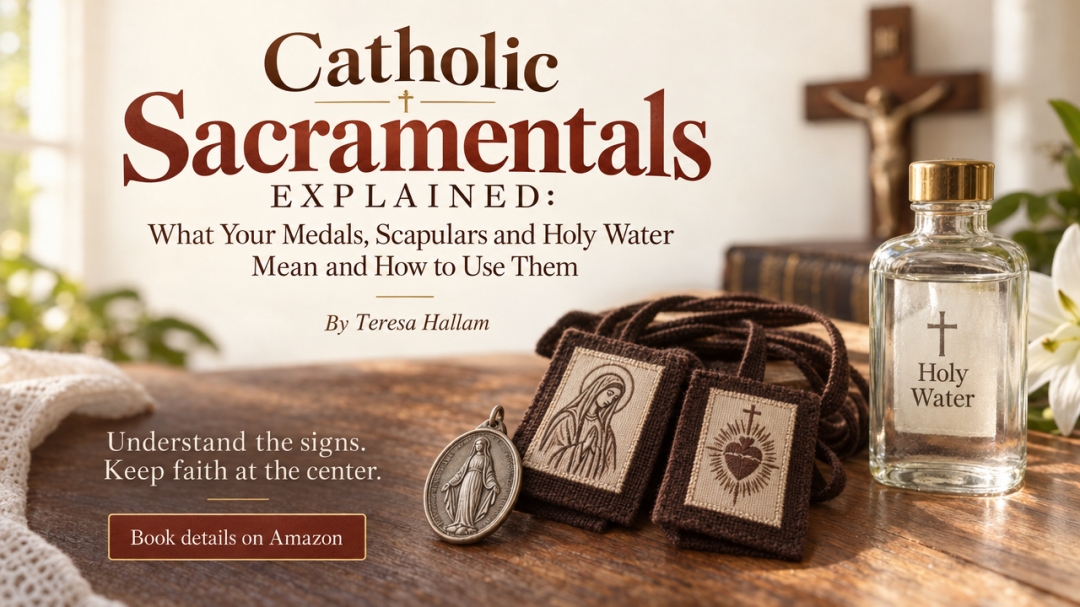
HOUSTON, TX – November 12, 2026 – Teresa Hallam’s Catholic Sacramentals Explained: What Your Medals, Scapulars and Holy Water Mean and How to Use Them, published November 10, 2026, introduces a practical guide to understanding familiar Catholic devotional objects. The book addresses a question that can arise with a medal received as a gift, a scapular worn beneath clothing or a bottle of holy water kept at home: what does the object mean, and how should it be used? Its central reader benefit is a framework that connects devotion with prayer, trust in God and responsible conduct rather than treating objects as sources of independent power.
The handbook can be read from beginning to end or consulted when a particular practice raises a question. Its coverage moves from the distinction between sacraments and sacramentals to individual medals, scapulars, household objects and customs throughout the Church year. That structure gives readers both a starting point and a way to return to a specific subject. Someone arranging a prayer corner, selecting a religious gift or deciding how to care for a devotional object can approach those choices within the same underlying understanding of faith.
What makes a sacramental different from a charm? In Hallam’s treatment, a sacramental directs the person beyond the object toward God, the Church’s prayer and a faithful response in daily life. A charm, by contrast, is treated as though its presence or a particular gesture could control an outcome. The book explains that a blessing does not make an object magical, permanently lucky or immune to damage. A medal may prompt prayer and imitation of a saint’s virtues, but it does not guarantee safety or remove the need for wise decisions.
This distinction also establishes the relationship between sacramentals and the sacraments. The book presents sacramentals as supports for the life of faith, not alternatives to confession, the Eucharist or other sacraments. Its discussion of blessings extends beyond religious articles to people, places and activities. A blessed home may still experience grief or conflict; a blessed vehicle still requires an attentive driver. Rather than promising immunity from difficulty, the handbook connects these practices with hospitality, forgiveness, patience and care for others.
Holy water provides one of the clearest examples of the book’s approach. Why does holy water recall Baptism? Hallam presents its prayerful use as a reminder of the person’s Baptism and belonging to Christ, rather than as a new baptism or a source of automatic protection. The discussion pairs that devotional meaning with practical guidance about clean containers, closed storage, clear labeling and contamination. It also emphasizes consent: holy water should not be used secretly to manipulate someone or sprinkled on another person against that person’s wishes.
The same chapter draws a clear boundary between devotional use and health care. Holy water is described as blessed for prayer, not for sterilizing surfaces, cleaning wounds or treating illness. Respect for a sacred object therefore includes ordinary cleanliness and an understanding of its limits. This combination of religious meaning and practical care is a recurring feature of the handbook. Readers are encouraged to see responsible action as consistent with devotion, rather than as evidence that prayer or trust is lacking.
The chapters on medals explore the Miraculous Medal, Saint Christopher Medal and Saint Benedict Medal. Their meanings are considered alongside common misunderstandings about protection and the role of devotional reminders. The Saint Christopher discussion addresses the confusion surrounding his removal from the universal calendar and distinguishes that change from the idea that he ceased to be a saint. The Saint Benedict material likewise emphasizes that wearing a medal cannot replace medical attention, pastoral support, professional care or the obligations of Christian life.
The Brown and Green Scapulars receive similarly careful treatment. The book challenges the idea that wearing the Brown Scapular automatically guarantees salvation, placing its meaning within repentance, perseverance and a faithful relationship with Christ. Its treatment of the Green Scapular emphasizes patient prayer and respect for conscience rather than guaranteed conversion or recovery. These chapters also make room for practical questions about wearing, carrying, blessing and replacing devotional items, keeping the emphasis on the person’s response rather than anxiety about an object’s condition or placement.
Household devotion broadens the guide beyond objects worn or carried. Crucifixes, blessed salt, candles, holy cards, icons and statues appear alongside prayer corners, house blessings and car blessings. Hallam pairs candle use with stable holders, safe placement and flameless alternatives where open flames are unsuitable. The discussion of car blessings connects prayer with seat belts, maintenance and devotional reminders secured away from the driver’s view, controls and airbags. These examples make the book’s central distinction concrete: a religious practice should encourage care, not create confidence in invulnerability.
The Church-year material covers Epiphany chalk, Candlemas, Saint Blaise’s blessing, ashes, palms, Easter water, the Advent wreath and the Nativity scene. These subjects extend the handbook’s focus into recurring family and household customs. Guidance on gifts, thoughtful buying, blessings and retiring worn sacramentals adds another practical dimension. Across these topics, the book asks readers to consider not simply whether an object is present, but whether its use encourages prayer, reconciliation, charity and a more attentive Christian life.
Catholic Sacramentals Explained offers readers a way to approach familiar devotional objects with understanding rather than fear or exaggerated expectations. Its organizing principle remains consistent across water, metal, cloth, wax and household spaces: the object supports faith but does not control God or guarantee an outcome. Readers interested in the book can find further information on Amazon: https://www.amazon.com/dp/B0HR4L24HM. Additional book information is available through Book website.
Readers can explore related background through Sacramentals in everyday life..
About Teresa Hallam
Teresa Hallam is the author of Catholic Sacramentals Explained: What Your Medals, Scapulars and Holy Water Mean and How to Use Them. Her handbook explores Catholic devotional objects, blessings and household practices, connecting their religious meaning with prayer, responsible conduct and care for others. Its subjects include holy water, medals, scapulars and devotions throughout the Church year.
Video Link: https://www.youtube.com/embed/OuSjAlWk6Ss
Media Contact
Company Name: Catholic Sacramentals Explained
Contact Person: Teresa Hallam
Email: Send Email
Phone: 713-392-6222
Address:450 N Sam Houston Prky E Ste 103
City: Houston
State: TX
Country: United States
Website: https://y9rgibrniw2mq8jrirc4y6es.macaly.app
Press Release Distributed by ABNewswire.com
To view the original version on ABNewswire visit: Catholic Sacramentals Explained connects devotional objects with daily faith
