
GA, UNITED STATES, November 27, 2026 /EINPresswire.com/ — Dissipative microcavity solitons enable chip-scale frequency combs, yet lack agile pulse timing control. Scientists in China introduced dynamical soliton trapping to create optically timing-engineered microcombs (OTEM), achieving a slew rate 500 times faster than fiber-based TPFCs. Leveraging a single OTEM that acts as an effective dual-comb source, they demonstrated picometer-scale ranging precision—a new record for optical absolute ranging—and parallel sensing, opening new avenues for integrated chip-scale precision metrology and sensing.
Dissipative Kerr solitons in optical microresonators have revolutionized frequency comb technology, enabling chip-scale integration of spectrometers, optical frequency synthesizers, optical clocks, and LIDAR systems. However, integrated solitons have traditionally lacked agile control of comb parameters, particularly pulse timing control—a capability that has proven essential for pushing dual-comb measurement precision toward the quantum limit in fiber-based systems. The challenge has been that timing engineering in fiber combs requires self-referenced configurations and feedback loops, which remain difficult to implement on photonic chips.
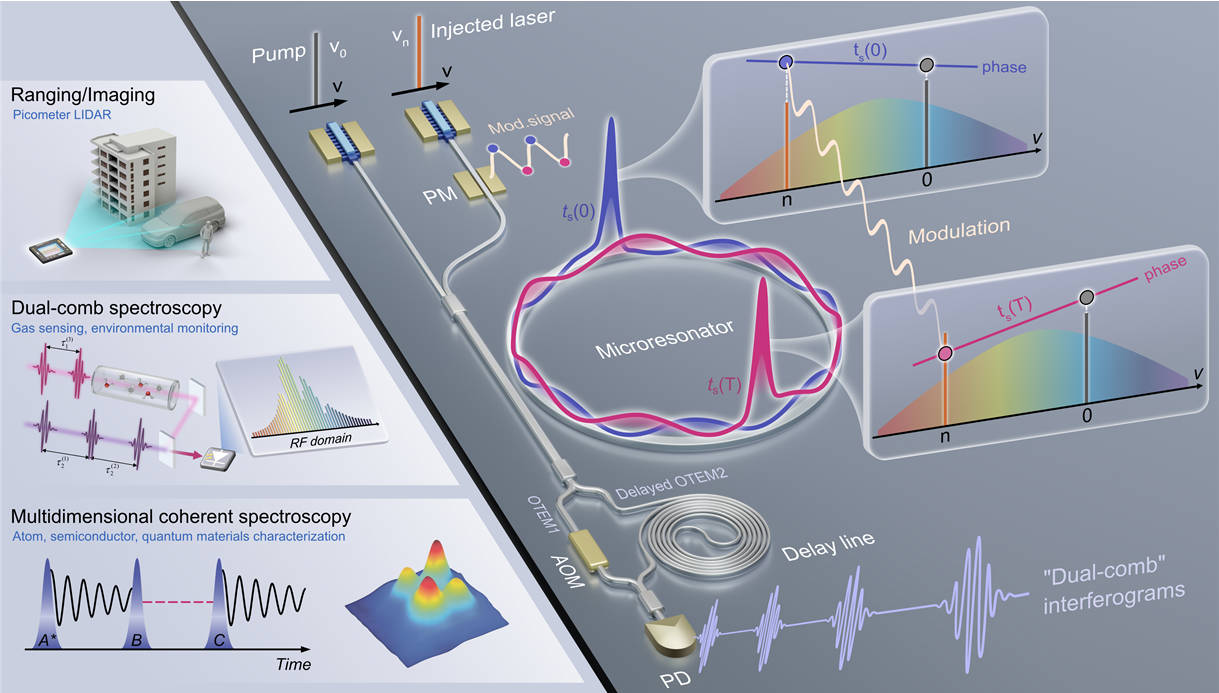
In a new paper published in eLight, a team of scientists led by Professor Chengying Bao from the State Key Laboratory of Precision Measurement Technology and Instruments, Department of Precision Instruments, Tsinghua University, and co-workers have developed an all-optical approach to timing engineering of microcavity solitons. They introduced dynamical soliton trapping to enable optically timing-engineered microcombs (OTEM). By injecting an auxiliary laser to anchor one of the microcomb lines, they create a potential well that traps and steers the soliton. Phase modulation of the injected laser then enables precise control of soliton timing in an all-optical manner, eliminating the need for electronic feedback loops and cavity actuators.
The OTEM demonstrates a response bandwidth exceeding 100 MHz and a soliton slew rate of 31.3 ps/μs, surpassing existing time-programmable fiber laser combs by more than two orders of magnitude. The team characterized the soliton timing response under various modulation waveforms—sine, triangle, square, and ramp waves—and retrieved all motion trajectories with high fidelity using heterodyne beat measurements. The measured response bandwidth scales with injected laser power in near-square-root fashion, in excellent agreement with theoretical predictions derived from the generalized Lugiato-Lefever equation.
“The all-optical approach simplifies the system architecture and enables a slew rate reaching 31.3 ps/μs, more than 500 times faster than fiber-based time-programmable frequency combs,” the scientists explain. “Our approach acts as a magnifier in timing engineering: a 2π phase shift corresponds to only 5 fs for a continuous-wave laser, but enables a temporal shift of a few picoseconds for an OTEM.”
Leveraging the timing scan capability, the team used a single OTEM for effective dual-comb ranging by splitting the comb into two arms and delaying one of them. This approach inherently resolves the mutual coherence challenge in traditional dual-comb systems. The OTEM naturally apodizes the interferogram, reducing photon waste and improving photon efficiency. The ranging precision reaches a normalized value of 2 pm·√s using interferometric phase analysis, and the absolute precision converges to 20 pm at 10 ms—establishing a new record for optical absolute ranging. The team also demonstrated absolute ranging through fluctuating flames, 3D imaging of a scattering aluminum plate with over 50 dB reflection loss, and parallel ranging by spatially dispersing the OTEM with a grating, achieving a sensitivity as high as 2.8 pm/√Hz using a single photodetector.
“The broad bandwidth of OTEM was harnessed for parallel ranging by spatially dispersing the comb in one dimension. A total of 25 RF comb lines were measured, and the measured vibration amplitudes exhibited an excellent linear relationship with the mode index, showcasing the parallel sensing capability,” the scientists note.
The reported technique transforms timing engineering of microcavity solitons and endows integrated dual-microcomb metrology systems with enhanced precision. Although the current system still relies heavily on fiber optics, recent progress in integrated photonics—including heterogeneous integration of lasers, electro-optic modulation on lithium niobate, and ultra-low-loss Si3N4 spiral waveguides—bodes well for future monolithic or hybrid integration of OTEM metrology chips. “Once realized, dynamical trapping and OTEM should enable compact dual-comb metrology chips, shifting the paradigm by using a single OTEM rather than two combs,” the scientists forecast. This breakthrough could open new avenues for chip-scale precision metrology, LIDAR, spectroscopy, and quantum-limited sensing.
References
DOI
10.1186/s43593-026-00140-1
Original Source URL
https://doi.org/10.1186/s43593-026-00140-1
Funding information
This work was supported by the Beijing Natural Science Foundation under Grant No. JQ25016; the National Key R&D Program of China under Grant No. 2023YFB3211200; the National Natural Science Foundation of China under Grant Nos. 62375150, 62250071, and 62175127; and the Tsinghua-Toyota Joint Research Fund.
Lucy Wang
BioDesign Research
email us here
Legal Disclaimer:
EIN Presswire provides this news content “as is” without warranty of any kind. We do not accept any responsibility or liability
for the accuracy, content, images, videos, licenses, completeness, legality, or reliability of the information contained in this
article. If you have any complaints or copyright issues related to this article, kindly contact the author above.

Media gallery